
Overview and summary
This training program was developed to support more engaging, technology-enhanced teaching at the University of West Florida. It equips faculty with practical skills to integrate H5P into their Canvas courses, enabling the design of interactive learning experiences that promote participation and deeper understanding. Since its launch, the program has been adopted across multiple departments, supporting scalable use of interactive content in instruction.

Process
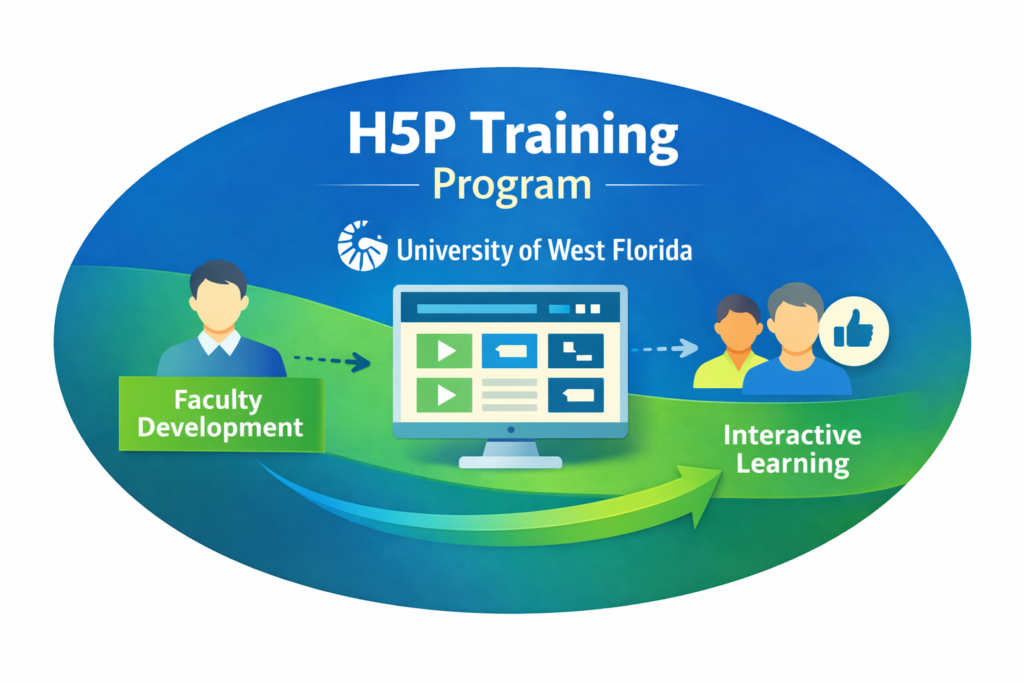
I collaborated with subject matter experts at the University of West Florida Center for Teaching, Learning, and Technology (CTLT) to align the H5P training with established faculty development standards. CTLT’s focus on quality, collaboration, and innovative technology guided the design approach.
I conducted targeted interviews to understand prior program structures, instructional strategies, and delivery models. Insights were synthesized, supported by AI-assisted organization and pattern identification, to inform a structured development plan and workflow. Through iterative collaboration, the training was designed to be practical, scalable, and aligned with faculty needs for integrating H5P into Canvas.
Learning theory
The design of this training was guided by constructivist learning principles, ensuring that faculty actively engaged with H5P tools to construct their own understanding of interactive course design. Rather than passively receiving information, participants explored H5P features through hands-on activities, applied their knowledge to real-world course development, and reflected on best practices. By aligning with constructivist strategies, the training empowered faculty to take ownership of their learning, fostering deeper comprehension and the ability to create student-centered, technology-enhanced learning experiences in Canvas.
Learning Management System
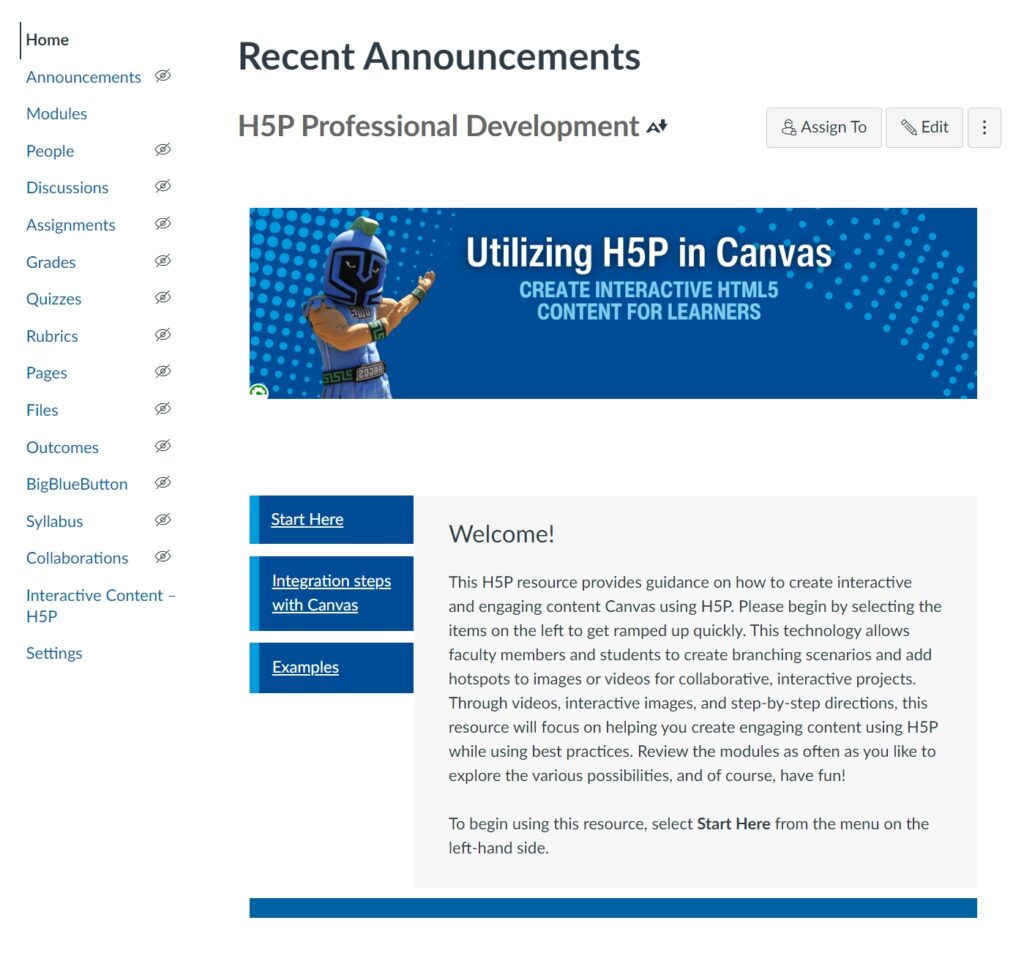
This training was designed in Canvas, the university’s official Learning Management System (LMS), ensuring seamless integration with existing faculty workflows. Using Canvas allowed participants to engage with H5P directly within their course environment, providing an authentic, hands-on experience that mirrored real classroom implementation
H5P training sample
Since this training is hosted by the University of West Florida, only a limited preview is available to provide an overview of the course structure. This preview highlights some of the interactive tools and offers a glimpse into the valuable experience faculty gained from the program.

Results & Impact
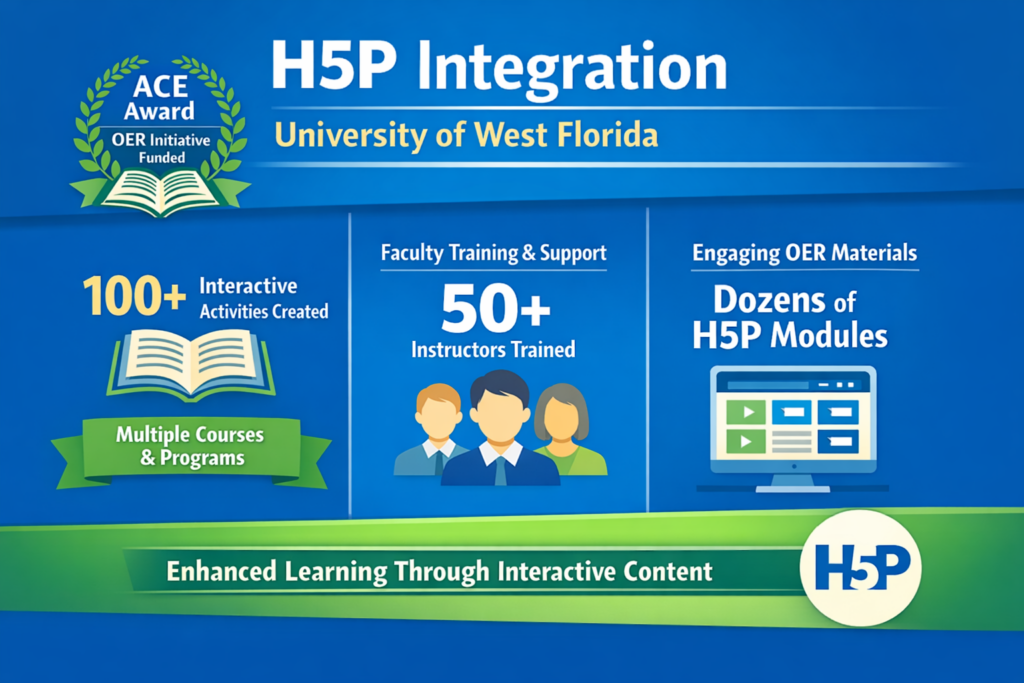
The H5P Faculty Training Course was officially adopted by the University of West Florida Center for Teaching, Learning, and Technology (CTLT). Following its implementation, the initiative scaled across multiple departments, equipping faculty with the skills to design and deliver interactive learning experiences within Canvas.
Quantitative Impact
- 50+ faculty members trained, expanding institutional capability in interactive course design
- 100+ H5P activities developed, including interactive videos, branching scenarios, and knowledge checks
- Dozens of course modules enhanced across multiple programs
- ~2+ interactive activities created per trained instructor, indicating strong application of learned skills
- Adoption across multiple departments, demonstrating scalability and organizational alignment
Qualitative Outcomes
- Increased student engagement through embedded, interactive learning experiences
- Shift from passive content delivery to active learning strategies among faculty
- Improved alignment between learning objectives, activities, and assessment
- Positive faculty feedback on usability and instructional value of H5P tools
Performance Insight
This initiative demonstrates how targeted faculty development can drive measurable improvements in instructional practices. By enabling instructors to create interactive, learner-centered experiences, the program supported scalable adoption of technology while strengthening instructional effectiveness across the institution.